


Li and Fu Publish on Nonlinear Alfvén Waves

Li and Fu Publish on Nonlinear Alfvén Waves
New Mexico Consortium scientists Feiyu Li and Sean Fu have recently published in Physics of Plasmas their latest progress on the topic of Alfvén wave parametric decay instability (PDI). This research represents the first-ever 3D, open-boundary, hybrid simulation modeling of PDI.
The simulation setup is highly relevant to the team’s ongoing Alfvén wave experiments with the Large Plasma Device (LAPD) at UCLA. Alfvén waves, a fundamental plasma wave mode, are prevalent in both space and laboratory plasmas when a background magnetic field is present. PDI, a crucial nonlinear mechanism, governs the energy transfer of Alfvén waves into plasmas, influencing important processes such as solar coronal heating and fusion performance.
 Image 1.
Alfvén wave PDI was predicted about 60 years ago; yet investigating this basic plasma process in the laboratory has been challenging because of the long wavelength of Alfvén waves. The LAPD, a 20-meter-long linear plasma device (see image 1), is uniquely positioned to study nonlinear Alfvén waves. Understanding the specific conditions necessary to excite PDI is essential for advancing experimental efforts and assessing its role in space plasma environments.
The 3D simulations, which incorporate comprehensive features of the device (see image 2), indicate that strong wave damping in laboratory plasmas is a significant obstacle to achieving PDI. The study identifies various damping effects and provides theoretical insights and optimization strategies aimed at achieving the first laboratory demonstration of PDI.
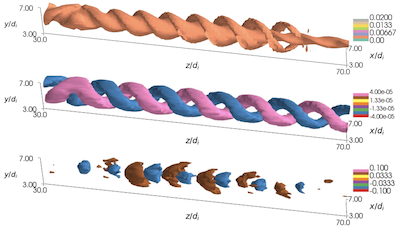 Image 2.
Additionally, the research highlights that PDI can be more readily excited in space plasma due to lower wave damping and the fact that PDI development is less affected by the wave scale perpendicular to the background magnetic field.
To learn more, read the full article at: Effects of wave damping and finite perpendicular scale on three-dimensional Alfven wave parametric decay in low-beta plasmas.
This research involved collaboration with Seth Dorfman from the Space Science Institute and was supported by the DOE and NASA.
Top image of Feiyu Li in front of the Large Plasma Device.