


Xiangrong Fu and Colleagues Uncover New Clues about Solar Wind Turbulence
Xiangrong Fu and Colleagues Uncover New Clues about Solar Wind Turbulence
A new study titled “Dual-band Ion-scale Waves in the Solar Wind: Statistical Properties and Comparison with Single-band Ion-scale Waves,” by Los Alamos National Laboratory and New Mexico Consortium scientist Xiangrong Fu and colleagues, has been published in The Astrophysical Journal Letters. The research provides important new insight into the interplay of large-scale turbulence in the solar wind and small-scale ion-scale waves.
Using observations from NASA’s Parker Solar Probe, the team conducted the first comprehensive statistical analysis of dual-band ion-scale waves (DBIWs) which are a newly recognized phenomenon where left-handed and right-handed wave packets appear simultaneously at near frequencies. This unique signature indicates the presence of bidirectional ion cyclotron waves, a relatively rare observation in the solar wind.
The study finds that DBIWs occur most frequently between 0.2 and 0.25 astronomical units from the Sun and are associated with strong Alfvénic turbulence, characterized by dominant perpendicular magnetic fluctuations and low compressibility. In contrast, more common single-band ion-scale waves peak closer to the Sun and decrease in frequency with distance.
These results support a physical scenario in which intense turbulent motions stochastically heat solar wind ions, creating temperature anisotropies that generate bidirectional ion cyclotron waves. The findings strengthen the scientific link between large-scale turbulence and micro-scale kinetic processes in the solar wind.
This research advances understanding of how energy is transported and dissipated in the solar wind and underscores the Parker Solar Probe’s vital role in revealing the complex physics of the Sun’s extended atmosphere.
To learn more see the entire paper at: “Dual-band Ion-scale Waves in the Solar Wind: Statistical Properties and Comparison with Single-band Ion-scale Waves.”
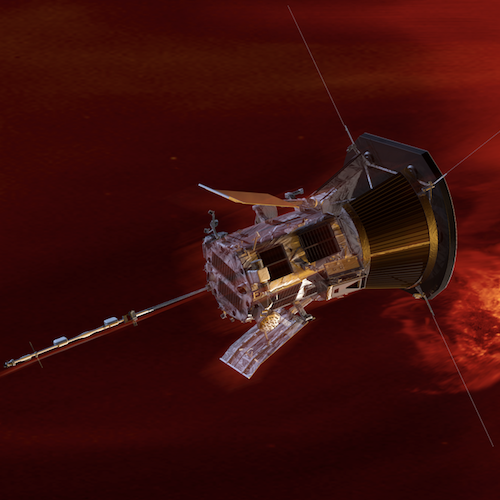
Top image is an artist’s concept of the NASA Parker Solar Probe. Credit to NASA-APL