


Sending Accelerators to Space: Reeves’ Work on BeamPIE Experiment

Sending Accelerators to Space: Reeves’ Work on BeamPIE Experiment
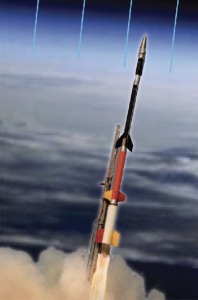 Geoff Reeves, one of the longest tenured scientists at the New Mexico Consortium, is currently collaborating on the Beam PIE rocket experiment, which was launched in November 2023.
In this project, Reeves collaborated with scientists at Los Alamos National Laboratory (LANL) and NASA’s Goddard Spaceflight Center to develop compact and robust particle accelerators suitable for space deployment. The goal of this project was to study new technologies for accelerators and also how electron beams create electromagnetic waves in space.
This technology has the potential to be utilized for the remediation of radiation belts lingering in the space above our atmosphere as a result of solar flares or high-altitude nuclear explosions, which have the potential to harm satellites.
In this experiment, they used an electron beam to generate VLF and HF radio waves in space using a 2-payload system – one with an electron accelerator and one with instruments to measure the waves. Over the course of the flight the experiment operated in different ambient plasma conditions and with different payload separations.The electron beam operated using a coded sequence of different frequencies and pulse lengths to very precisely test theoretical predictions and numerical simulations of beam-plasma-wave interactions.
While the BeamPIE accelerator successfully reached space and injected electrons into space, scientists are currently investigating why the experiment did not detect waves at the anticipated times and frequencies.
Reeves, in collaboration with colleagues at LANL, are currently in the process of initiating the Beam 2PIE experiment. This project serves as a continuation of their previous work, with comparable goals but a very different accelerator design. The proposed launch date for Beam 2PIE is set for 2028.