


Improving 3D Fire Behavior Modeling with New Framework from NMC Scientist Niko Tutland
Improving 3D Fire Modeling with New Framework from NMC Scientist Niko Tutland
New Mexico Consortium (NMC) scientist Niko Tutland has co-authored a new publication in Fire Ecology that offers a major advancement in how scientists represent fuels in 3D fire behavior models. The paper, titled “Representing 3-dimensional fuels for physics-based fire behavior models: a general framework and case study in a type-converted post-fire shrubfield,” introduces a new approach to better model the complex vegetation that fuels wildfires.
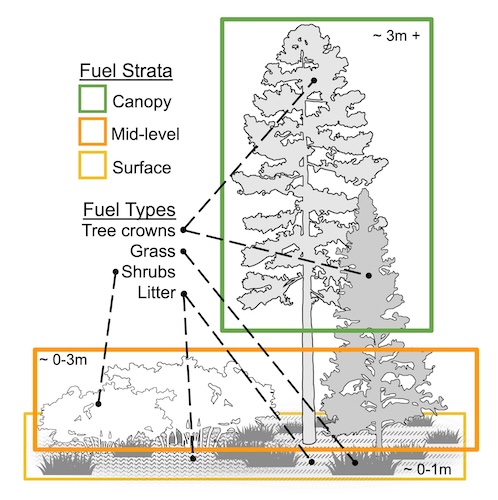
Accurately modeling how wildfires and prescribed fires behave depends on detailed information about the fuels on the ground—especially the 3D structure of plants like shrubs and small trees. These so-called “mid-level fuels” are tricky to model because they are often hidden from satellite or airborne sensors and haven’t been studied as thoroughly as grasses or large trees. Yet, they play a critical role in how fires spread, especially in landscapes recovering from wildfire.
Tutland and co-authors developed a new general tool called the Framework for Representing 3D Fuels (FR3D). This framework helps researchers combine different types of data and methods to build more accurate 3D fuel models—whether in forests, shrublands, or grasslands.
The team demonstrated FR3D in a real-world case study in a fire-altered, shrub-dominated landscape. They tested three ways of modeling mid-level shrub fuels using advanced laser scanning and computer modeling techniques. Then, they used these fuel models to simulate fire behavior using the QUIC-Fire physics-based fire model.
All three methods produced realistic models of how fire might behave in the area, but the details of shrub height, density, and coverage varied depending on the approach. These differences influenced fire spread and fuel consumption, highlighting how critical accurate fuel modeling is for predicting fire outcomes.
The study shows that how scientists model shrubs and other mid-level vegetation can significantly affect fire behavior predictions. The new FR3D framework offers a better way to build better fuel models that are tailored to specific sites and data availability.
This research lays the foundation for improving the planning of prescribed burns and wildfire mitigation efforts and helps make fire-prone landscapes safer and more resilient.
Read the full article in Fire Ecology: https://doi.org/10.1186/s42408-025-00246-w
Top image caption: The Framework for Representing 3D Fuels works by combining data from laser scanning, aerial imagery, and field surveys to model 3D fuel structure for different fuel types and vertical strata